Originally published: March 2023, Last updated: July 2026
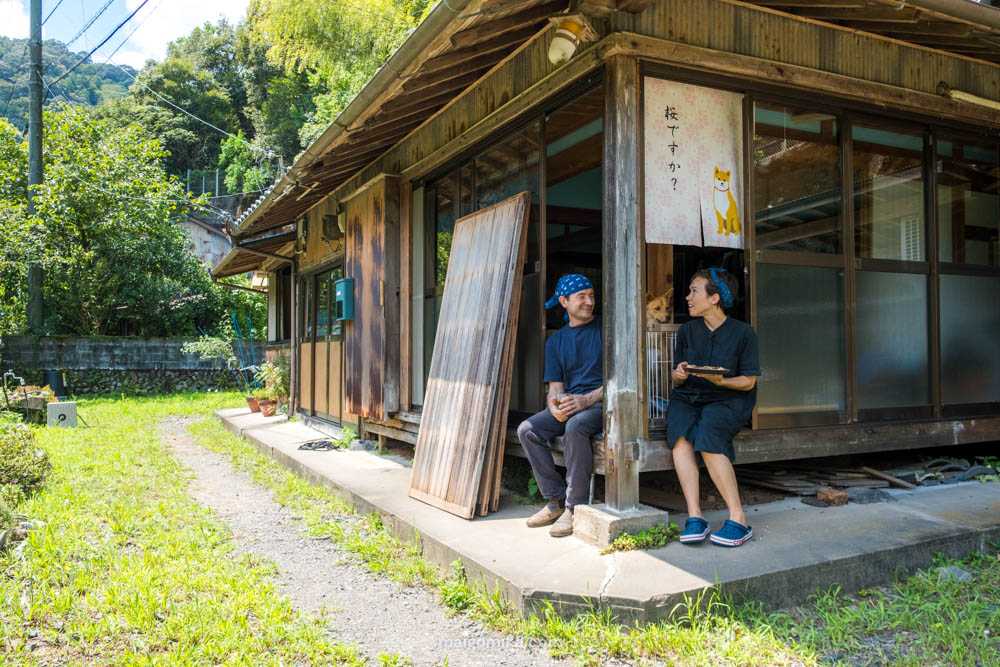
When Jesse and I first moved to Japan, the idea of owning an akiya, a long-neglected, often charmingly dilapidated countryside home, felt like the perfect blend of adventure, affordability, and a chance to root ourselves in rural life. We’d drive past sagging rooflines and mossy engawas, look at each other, and whisper, “Maybe this one…?”
But once we actually started searching, we quickly learned that the world of akiya isn’t as simple as the viral articles make it out to be. “Free houses” often cost a fortune to repair. Listings vanish before you can inquire. Ownership can be a tangled, multi-heir puzzle. And those dreamy countryside locations? They can be remote. Really remote — especially in Japan’s rural areas.
After years of navigating akiya banks, meeting with agents, and eventually buying our own akiya through community ties, we’ve learned a lot from the inside, especially about what proper due diligence really looks like when purchasing an akiya in Japan.
This guide is for anyone who’s curious about what akiya ownership actually involves. From where to find listings and how foreign buyers can navigate the process to the hidden costs, local relationships, and professionals you’ll likely need along the way, I’ll walk you through what it’s really like to buy and restore an akiya.
📋 Key Takeaways:
- Foreigners can buy property in Japan, but owning a house does not grant residency
- “Free akiya” homes are rarely free, and often come with high repair costs or complex paperwork
- A neglected akiya can lose valuable property tax reductions and become significantly more expensive to own
- Many akiya houses are never listed online, so local connections can make a big difference
- Recent changes to the Building Standards Act mean that some renovations once allowed may now require additional approvals.
- Farmland rules can limit what you can buy, depending on your visa status and location
- What is an Akiya House (空き家)?
- What We Learned During Our Akiya Hunt
- Why Community Connections Matter (Especially in Rural Japan)
- Where to Find Akiya Listings?
- Searching from Japan vs Overseas: What to Expect
- Your Akiya Support Team: Who You’ll Need When Purchasing an Akiya
- Legal & Practical Considerations (Especially for Foreign Buyers)
- A Due Diligence Checklist Before Buying an Akiya
- Unclear Ownership & Missing Heirs
- Hidden Land Details & Zoning Rules
- Many Akiya Aren’t Actually Empty
- Old Houses Predate Modern Infrastructure
- Permit Requirements Under Japan’s Building Standards Act
- Non-Rebuildable Properties
- Remote Living Realities May Require More Effort
- Taxes, Fees, and Other Hidden Costs
- Is an Akiya Worth It?
- FAQ on Buying an Akiya
What is an Akiya House (空き家)?
The word akiya (空き家) literally means “vacant house” in Japanese — 空き (aki) meaning empty or vacant, and 家 (ya) meaning house. But in Japan, an akiya is more than just an unoccupied home.
According to Japan’s Ministry of Land, Infrastructure, Transport and Tourism, an akiya generally refers to a residential building that has been unoccupied and unused for an extended period, often more than one year.
These homes typically show clear signs of long-term vacancy: no regular human activity, disconnected utilities such as electricity or water, and no plans for the previous residents to return.
On the other hand, if a house is still maintained, cleaned regularly, or connected to basic utilities, it may not be considered an akiya, even if there are no occupants living there.
Behind this definition lies a much larger story — one connected to rural depopulation, aging communities, inheritance laws, and the realities of Japanese real estate outside the major cities.

Why Does Japan Have So Many Akiya?
In many rural areas, older generations pass on, and the family home is left behind—often because the next generation has already built a life elsewhere. Even when there are heirs, sorting out ownership can take years, especially with older records and multiple family members involved.
And then there’s the homes themselves. Many require more work than expected, and the cost of repair—or even removal—can outweigh their value.
Taken together, it starts to explain why so many houses remain just as they were left.
According to the Ministry of Internal Affairs and Communications, there were 9 million akiya in 2023, an increase of over 500,000 homes since 2018.

Are There Houses That Are Really Free?
Short answer: yes… well, sort of.
We’ve found ¥0 homes listed across Japan on sites like Zero Estate. In some cases, owners are simply hoping someone will take the property off their hands, sometimes highlighting nearby farmland, storage buildings, or the quiet rural lifestyle that comes with it.
But these homes are usually “free” for a reason.
Many come with serious structural problems, years of neglect, or legal complications that make selling them difficult. Common issues include:
- Come with major structural issues.
- Outdated plumbing and electrical systems
- Non-buildable land restrictions
- Overgrown properties and abandoned belongings
We once toured a “free” house that would have required a near-complete rebuild just to make it livable. Others lacked proper road access, making renovations far more complicated and expensive. And, while houses may be more affordable, renovation costs in Japan are rarely cheap.
In areas with little housing demand, even selling a home can become nearly impossible, which is why some owners decide giving it away is the simplest option.
So while the purchase price of an akiya can technically be zero, the real cost of restoring and maintaining one rarely is.

Can Foreigners Buy an Akiya?
Yes, you can buy property in Japan regardless of your nationality or visa. But—and this is a big but—owning property does not grant residency or long-term stay rights.
If you want to live in your akiya full-time, you will still need to qualify for a long-term visa, such as:
- a work visa
- a spouse/dependent visa
- permanent residency
New 2026 Reporting Requirement for Foreign Buyers
As of April 1, 2026, foreign buyers who are not residents of Japan must generally submit a post-acquisition report under Japan’s revised Foreign Exchange and Foreign Trade Act (FEFTA), even when purchasing residential property for personal use.
Previously, purchases of homes intended for personal residence or vacation use were often exempt from this reporting requirement. Under the revised rules, overseas buyers are now typically required to file a report with the Ministry of Finance (via the Bank of Japan) using Form 22 within 20 days of acquiring the property.
In practice, many buyers have their judicial scrivener or real estate professional assist with the paperwork, but you should never assume it is being handled automatically. Before closing, confirm who is responsible for filing any required FEFTA reports and whether additional documentation will be needed.

Who Should Buy an Akiya?
If you’re planning to live in Japan long-term—or own a vacation home that you can regularly maintain—an akiya can make a lot of sense. An akiya is best suited for someone who isn’t relying on the house as a financial investment. It also helps to enjoy DIY projects—or at least be willing to learn.
You should be financially prepared and patient, whether that means paying for renovations, routine upkeep, or hiring someone to manage the property while you’re away. Renovating and maintaining an akiya is rarely a quick or inexpensive process, and progress often comes in small steps.
Who Shouldn’t Buy an Akiya?
If you’re looking for a fast return on investment, an akiya may not be the right choice. While there are exceptions, older homes in rural Japan typically depreciate rather than appreciate. Renovation costs can easily exceed the property’s resale value, and demand in remote areas can be limited. If your primary motivation is financial gain, this path may be frustrating.
Likewise, if you’re looking for a home that’s move-in ready with little or no work, an akiya may not meet your expectations. While some are in excellent condition, many require repairs or modernization. Even well-maintained homes can hide aging wiring, plumbing, insulation, or structural issues. These houses were built for a different era, and bringing them up to modern standards often takes time, money, and patience.
If you’re still unsure whether this akiya life is for you, read: Is Japanese Country Life For You? 7 Truths To Consider First.
What We Learned During Our Akiya Hunt
When we first began looking, we leaned heavily on akiya bank websites and online listings, imagining what might be out there. But it didn’t take long to notice the gaps.
Some listings had been sitting untouched for years. Photos often didn’t show the full picture.
And the biggest takeaway of all:
Many of the best houses never make it online.
We’ve experienced this twice now—first with the akiya we rented when we arrived, and later with the one we eventually bought after years of searching. Both came through simple conversations and community connections… and neither had ever been listed anywhere.
Why Community Connections Matter (Especially in Rural Japan)
We didn’t fully understand this until we lived here. While akiya banks are a helpful starting point, we quickly realized how limited they can be on their own.
In many rural areas, the akiya market still lives offline—through introductions, trust, and word of mouth.
While less important in urban areas, many rural sellers are not just looking to sell a house. They’re looking for someone who will become part of the community. Because of that, they often prefer:
- A stable, long-term presence
- Direct introductions through people they trust
- Someone already connected, even loosely, to the area
Being here in Japan—and slowly building those connections—made all the difference for us.
One thing to keep in mind: homes found through local introductions aren’t always ready to be sold.
Unlike listed properties, where paperwork is often already in place, unlisted homes can require a bit more behind-the-scenes work—like confirming ownership, locating heirs, or completing inheritance registration before a sale can move forward.
Therefore, online listings are still where most searches begin—and they can be a helpful starting point, as long as you understand their limits.
Where to Find Akiya Listings?
If you’re beginning your search, there are a few different paths you can take—some more direct, others a bit more exploratory. Most people start online, and it’s still one of the easiest ways to get a feel for what’s out there.
Akiya Banks in Japanese
If you’re comfortable navigating Japanese websites—or already living here— a Japanese “akiya bank” (空き家バンク) is often the most comprehensive place to start.
These aggregate website portals are often free to access and list vacant homes, uploaded by real estate agents. Their offerings can range from basic photo listings to condition reports and virtual tours.
Akiya-At Home
Akiya-At Home is one of the largest Japanese databases of registered vacant houses, with a map categorizing a list of akiya houses for each prefecture in Japan, which you can filter via city name to fine-tune your search.
Lifull Homes
Lifull Homes, like Akiya-At Home, is another large-scale database of registered vacant houses. Lifull Homes is also organized similarly, and while there is overlap in houses on both sites, I do occasionally stumble on a few new house listings here.
Ministry of Land, Infrastructure, and Transport
The Ministry of Land, Infrastructure, and Transport might be one of the most bureaucratic-looking akiya banks out there.
But, what it lacks in looks, it makes up for with links to the local government-run akiya bank sites organized by prefecture and city. It may not look like much, but it’s a useful starting point if you already know the area you’re searching in.
Zero Estate
Zero Estate is a Japanese akiya website that focuses on so-called “free” houses—properties often listed at little to no cost, usually in need of significant repair.
Japan Organization for Internal Migration (JOIN)
If you’re thinking not just about buying a house, but actually relocating to the countryside, JOIN is a helpful place to explore.
It’s a national organization that works with local governments across Japan to support people interested in moving from cities to more rural areas. Through their network, you can find information on different regions, housing opportunities, and local support systems—often directly from the municipalities themselves.
It’s a national organization that works with local governments across Japan to support people interested in moving from cities to more rural areas. Through their network, you can find information on different regions, housing opportunities, and local support systems—often directly from the municipalities themselves.
This tends to be most useful if you’re already living in Japan—or planning to do so long-term, as many of the opportunities are designed with residents in mind.
Akiya Banks in English
For those searching from abroad or who prefer to work in English, there are a few English-language akiya bank platforms that make the process feel a bit more approachable.
Mokomoko
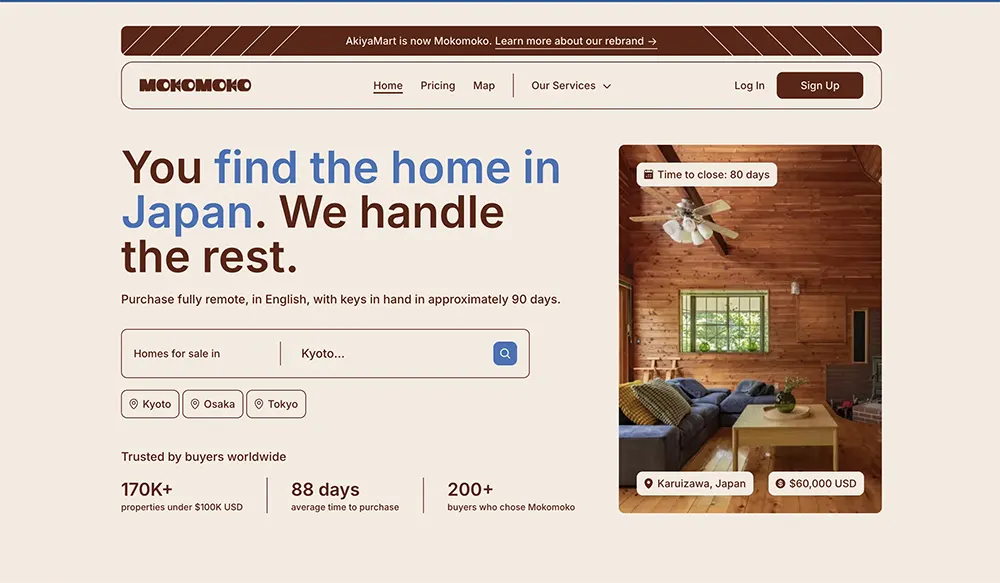
If you’re searching from abroad—or just prefer navigating things in English—Mokomoko (previously known as Akiyamart) is one of the more approachable ways to explore the akiya market.
It takes what can often feel like dense, hard-to-read Japanese listings and turns them into something much easier to browse, with a simple, map-based layout. They also offer support through fully remote, English-speaking licensed agents, which can make the process feel a lot less overwhelming, especially in the early stages.
There’s a free version to get a feel for the platform, along with paid plans if you want fuller access to listings.
Plans: Free, Basic ($6), Pro ($15/month or $11/month annually)
Discount: Use code MAIGOMIKA for 30% off Mokomoko Pro.
CheapHousesJapan.com
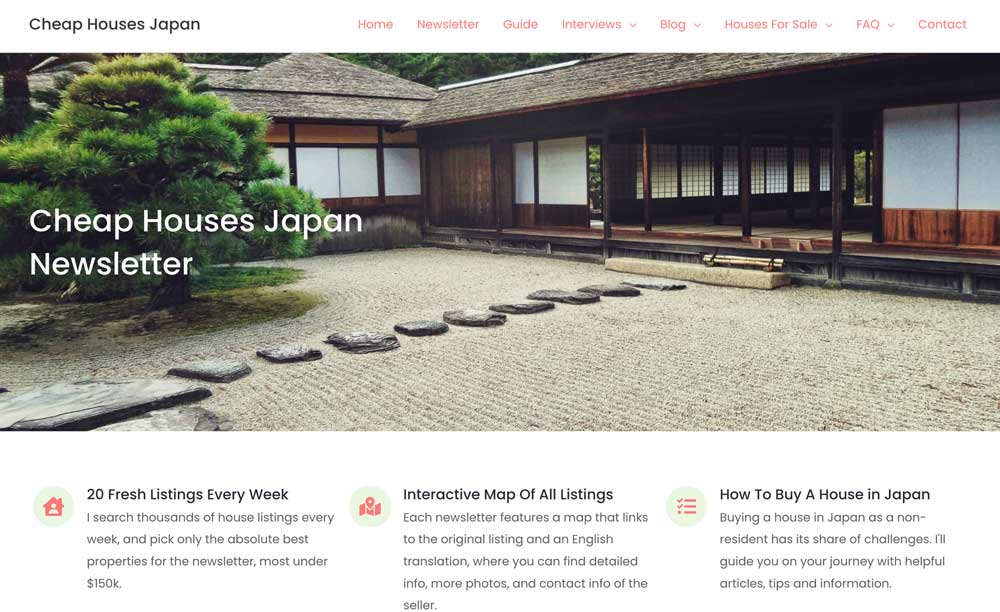
If scrolling through endless listings starts to feel overwhelming, CheapHousesJapan.com offers a quieter way to keep up with what’s out there.
Each week, the founder, Michael (Cheap Houses Japan founder), goes through thousands of listings and sends out a curated selection of 20 homes. It’s a simple way to get a sense of the market without having to search constantly—and to see the kinds of properties that tend to surface over time.
The newsletter is subscription-based, with a few added extras like renovation discounts and a guide on buying a home in Japan.
Subscription: $10/month or $90/year
Koryoya
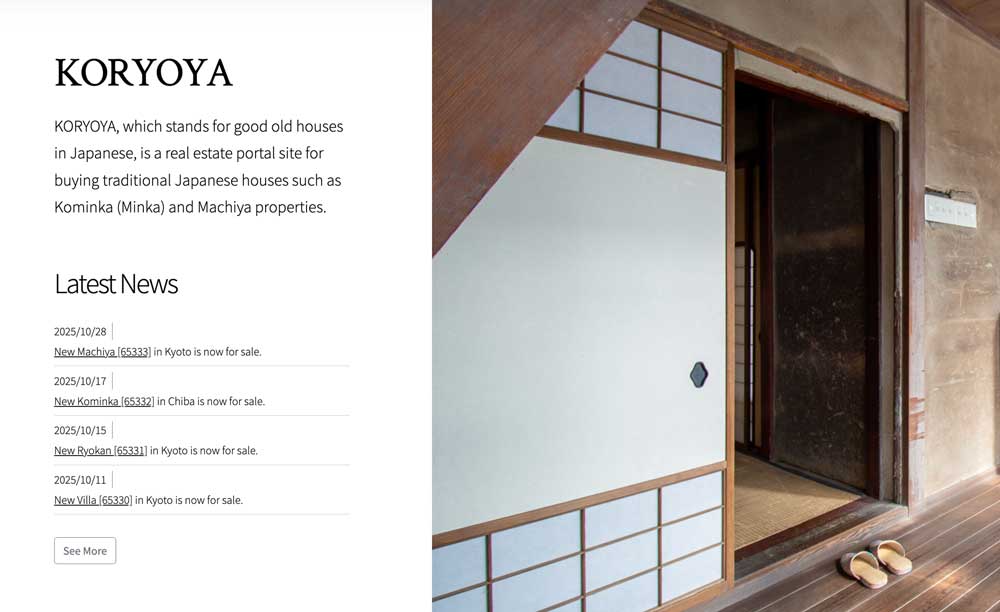
Koryoya is a little different—it’s not a buying platform, but more of a window into what’s possible.
They highlight beautifully preserved kominka and traditional merchant homes, often from before the 1950s. It’s a lovely place to explore if you’re drawn to older architecture, or just want a better sense of the kinds of homes that exist beyond standard listings.
They also link out to local municipalities, which can sometimes lead you a step closer to what you’re looking for.

Municipal Akiya Banks
There’s also a more local layer to the search through municipal government-run akiya banks. These often include listings that don’t appear on larger aggregate sites, making them a great place to find more hidden, hyper-local homes.
Most of these programs are designed for residents, which means overseas buyers typically won’t be able to register or apply directly.
That said, they can still be useful for research—or as a starting point if you’re planning to move to Japan, work with a local contact, or eventually search from within the country.

Searching from Japan vs Overseas: What to Expect
I often tell people that the biggest hurdle isn’t just the language barrier—it’s whether you’re searching from overseas or as a resident.
If you’re looking from abroad, seeing homes in person usually means committing to at least one trip. And if you want to get a real sense of an area—not just the house itself—planning for a few visits can make a big difference.
In this case, you’ll be relying on maps, translation apps, and messaging agents constantly. I usually travel with an eSIM → Saily (MAIGOMIKA10 for 10% off) or a Pocket WiFi (Japan Wireless or Sakura Mobile) if your phone isn’t eSIM compatible.
If you live in Japan, you can access local leverage and insights into the area.
In our case, our residency status gave us access to a community support network. It meant being able to lean on locals to help guide our search. Having community connections can literally open doors to unlisted houses that aren’t on any aggregate website, which was invaluable when choosing our long-term home.

Your Akiya Support Team: Who You’ll Need When Purchasing an Akiya
Buying an akiya involves more than picking a house online; it’s also packed with tricky legal and administrative hurdles—things like unpaid taxes, tangled inheritance disputes, and finding all the legal heirs. You definitely want a professional team on your side! Here’s the team that makes everything possible.
Real Estate Agents (Bilingual vs Local)
Though real estate agents are not legally required for house purchases, they can offer much-needed support, especially if you are unfamiliar with the legal processes of buying a home in Japan. There are two types:
Bilingual Agents are great for clear communication and simplifying complex documents, especially if you’re searching from abroad. However, one con is that the agent might not be a true local to the specific area, meaning they may miss available houses or subtle nuances of hyper-regional quirks, such as zoning rules.
A local agent, on the other hand, will have deep area knowledge, have access to off-market houses, and help overcome your “outsider” status. They can be harder to find online, and the language barrier is often significant, usually requiring reliable translation support just to engage them.
Think of it this way: The Bilingual Agent is your translator and legal communicator; the Local Agent is your community insider and negotiator.
Beyond your real estate agent, you’ll need two key types of legal scriveners to handle the heavy administrative and judicial lifting.
Judicial Scrivener (Shihō-shoshi)
The Judicial Scrivener (司法書士, shihō-shoshi) specializes in preparing documents for registration at the Legal Affairs Bureau, untangling inheritance issues, verifying and tracking down property heirs, and ensuring the inheritance process is legally completed before the property is transferred to you.
If the property hasn’t had updated registrations in decades (which is common), a judicial scrivener is non-negotiable.
Administrative Scrivener (Gyōsei-Shoshi)
The Administrative Scrivener (行政書士, gyōsei-shoshi) primarily prepares documents for submission to government agencies; for example, they handle applications for permission from the Agricultural Committee if your property includes farm land.
(P.S. An Administrative scrivener also provides legal assistance for visa applications or renewals in Japan.)
Legal & Practical Considerations (Especially for Foreign Buyers)
No matter where you’re searching from, there are a few legal and practical details that can affect what you’re able to buy and how you go about it.
Restrictions on Buying Farmland
One of the biggest surprises for many akiya buyers is that farmland in Japan follows very different rules from regular residential land.
If a property includes rice fields (tanbo / 田んぼ) or farmland (hatake / 畑), you generally can’t purchase or transfer that land without approval from the local Agricultural Committee (農業委員会).
Japan’s Agricultural Land Act is designed to protect domestic food production, and buyers are typically expected to actively farm the land rather than hold it as an investment or hobby property.
In many areas, this means demonstrating that you intend to cultivate the land and maintain it on an ongoing basis. Some municipalities may expect owners to farm for around 150 days per year or meet other local requirements.
Tip: If you’re unsure whether farmland is included with a property, check with the local city hall or Agricultural Committee. In some cases, the current owner (or a relative) may need to provide identification before certain land records can be viewed.
Foreign buyers should be aware that regulations became stricter in April 2025. As a general rule, non-residents and people visiting Japan on short-term visas cannot acquire agricultural land.
This means that when viewing an akiya advertised as a “vacant house with a garden,” it’s worth confirming whether that garden is actually included in the sale or classified as farmland.
In practice, purchasing farmland is usually only possible for those who legally reside in Japan, hold an appropriate long-term residence status, and can demonstrate a genuine intention to engage in farming.
Depending on the municipality, additional requirements may apply, such as:
- Permanent Residency or another long-term residence status
- A Business Manager visa connected to an active agricultural business
- Proof of farming plans and ongoing agricultural activity
- In some cases, employing full-time agricultural workers
Even if you cannot legally purchase the farmland itself, renting it may still be possible. This generally requires a formal lease approved by the Agricultural Committee, along with an agreement that the land will be actively maintained and cultivated.
Because agricultural land regulations can vary significantly between municipalities, always confirm the current requirements with the local Agricultural Committee or your real estate agent before making plans to buy.
Property Registration Now Requires Nationality Disclosure
Japan has also introduced new registration requirements for overseas property owners.
Following amendments to the Real Property Registration Rules that took effect in 2026, foreign buyers registering real estate must provide documentation confirming their nationality, such as a copy of a passport or a residence certificate. Full enforcement begins on October 5, 2026.
The information is collected for administrative and statistical purposes and will not be publicly displayed on the property registry itself.
For most buyers, this simply means providing one additional document during the registration process. It does not restrict foreigners from purchasing property in Japan. Your judicial scrivener will usually coordinate the nationality disclosure requirements as part of the ownership registration process.
Setting Up Utilities as a Non-Resident
Setting up essential utilities for your house often requires a Japanese bank account or proof of residency, making direct setup almost impossible on short-term visas such as a tourist visa.
Your best approach is to hire a property management company. These specialized services are designed to assist non-residents by handling:
- Setting up and paying utility bills
- Managing necessary installations (like gas)
- Handling mail and routine maintenance

The “Dump Access” Hurdle for Overseas Buyers
Another hurdle for people clearing out a house: many municipal dumps or disposal sites require that you be:
- a resident of that city/town, or
- able to prove you live in that area (address on ID/resident card)
One workaround is, if your ID doesn’t show your local address yet, bring a copy of your real estate registration certificate (不動産登記権利情報) — it lists your property address and can help when you need proof for local services.
Otherwise, if the cleanup feels overwhelming, you have a few options:
- Hire a cleanup company to empty the house: This can be expensive, but it’s often the most efficient solution — especially if you live far away, don’t have a vehicle, or can’t access local disposal sites.
- Hire a renovation contractor who handles disposal: Many renovation teams can include debris disposal and junk removal (though this is often an extra cost on top of their quote)
A Due Diligence Checklist Before Buying an Akiya
Akiya purchases can go wrong because people skip registry checks, underestimate structural problems, don’t confirm land zoning, or budget properly for permit costs. Here is a due diligence checklist before you sign anything:
Unclear Ownership & Missing Heirs
How much of an issue this becomes often depends on how you find the house.
If you are purchasing through a real estate agent, much of the ownership research and inheritance paperwork may have already been sorted out before the property is listed for sale.
But if you are searching locally through community connections (like we did), those legal details may still be unresolved.
When it comes to finding a single owner to purchase an akiya house, especially one that has been abandoned for an extended period, it can become complicated… fast.
Some akiya have:
- Deceased owners
- Multiple heirs or co-owners
- Unregistered inheritance transfers
- Missing or difficult-to-contact family members
A common issue is unclear lineage. If the original homeowner passes without a will, the property passes to the homeowner’s descendants, including those across multiple generations. This often requires locating all these descendants to secure the necessary approvals for a sale.
Although Japan’s 2024 Real Property Registration Act mandates that inheritance is registered within three years, many properties still list deceased owners or have numerous, potentially untraceable co-owners.
This is one of the biggest advantages of searching real estate sites or English akiya bank sites rather than relying on off-market local searches.
This is one reason many buyers start with established real estate platforms like Mokomoko rather than relying entirely on off-market searches. A lot of the ownership checks and inheritance paperwork have often already been resolved before the property is publicly listed.
If you want to start browsing on Mokomoko Pro, I have a 30% MAIGOMIKA discount to get you started on your akiya hunting journey.
Before anything else, confirm:
- Who is listed as the legal owner on the registry?
- Is the owner alive?
- Are there multiple heirs/co-owners?
- Has inheritance been properly registered?
- Whether all relevant heirs agree to sell
If the ownership situation is unclear, assume the process will take longer — or stop entirely — unless a professional untangles it.
📌 Who helps: a judicial scrivener (司法書士 / shihō-shoshi) can hunt down the heirs and navigate these inheritance issues.
Hidden Land Details & Zoning Rules
This sounds obvious, but with akiya listings, the land details aren’t always clear.
Sometimes you’re buying:
- The house, but not the land
- Land parcels are split across multiple lots
- Agricultural Land
- Access routes that may or may not legally belong to the property
Sometimes, the property may include multiple land parcels, like:
- Residential land (宅地)
- Farmland (often listed as 田 (rice field) or 畑 (field) on zoning maps
- Forest land (山林)
- Storage sheds (倉庫)
So, before you say yes to the house, confirm:
- Exact land parcel numbers (筆, hitsu)
- Boundary disputes / unclear borders
- Whether you have proper road access
- Land category (residential vs farmland vs forest land)
One area where many overseas buyers get blindsided is: If the property includes farmland — like rice fields (田 / tanbo) or fields (畑 / hatake) — you may need approval from the Agricultural Committee (農業委員会) to make the purchase legal, and requirements vary by region.
In this case, confirm:
- Whether farming use is required
- Whether you can legally acquire it based on your visa/residency status
- Whether it can be changed to other land types
📌 Who helps: real estate agent + judicial scrivener; sometimes a land surveyor. (For farmland changes: 行政書士 / gyōsei-shoshi)
Many Akiya Aren’t Actually Empty
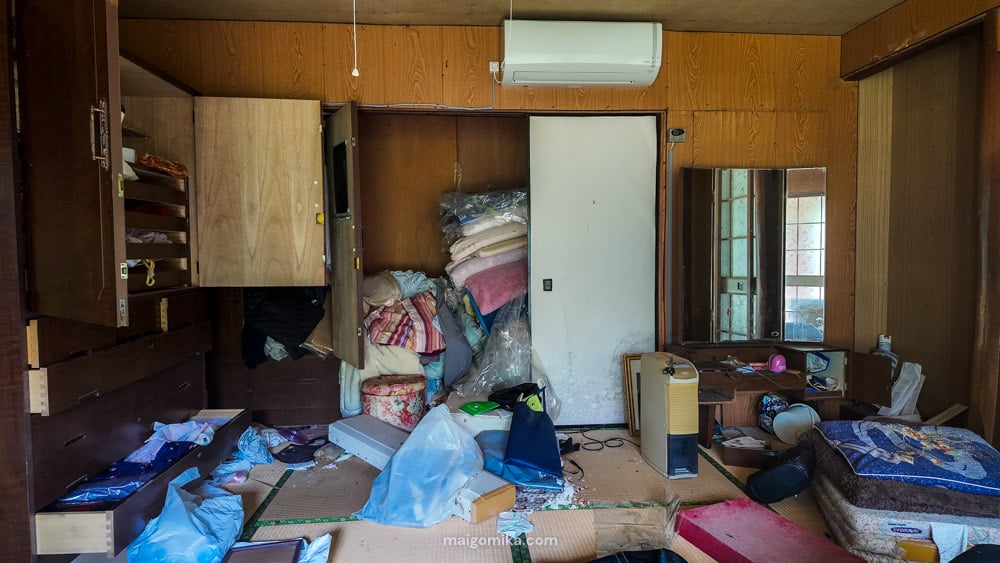
A lot of old houses… aren’t empty.
Many akiya were abandoned quickly, or slowly drifted into neglect over time, which means the house may still be full of the former owner’s belongings. Furniture, dishes, clothes, photos, old tools, paperwork, broken appliances… sometimes even decades of accumulated household life.
When you buy the property, the responsibility of clearing it out becomes yours.
This can add an extra layer of cost that most buyers don’t budget for, both in money and in time.
If you’re curious what that process actually looks like, I wrote more about it here: A Guide to Garbage Disposal When Renovating an Akiya House in Japan
Part of that is because Japan’s garbage disposal system is quite strict. In many areas, you’ll be required to separate waste into categories like:
- burnable garbage
- non-burnable garbage
- oversized items (粗大ごみ / sodai gomi)
- electronics and appliances
- metal items
If you’re renovating, construction materials are often separated again (for example, drywall vs. wood) and sometimes require disposal at different facilities.
That means you may end up making multiple dump runs to multiple locations over weeks or months—and yes, you usually pay fees along the way.

Old Houses Predate Modern Infrastructure
This is where “cheap” becomes “oh no.”
Although these old homes offer an opportunity for affordable housing, many require extensive renovations, including structural repairs, foundation reinforcement, roof replacements, termite treatment, and insulation upgrades, not to mention basic cosmetic enhancements.
Restoring an akiya also takes a significant investment of time. Depending on the condition of the property — and how much work you plan to take on yourself — renovations can easily stretch into months or even years.
And the older the house is, the more likely it is to predate modern infrastructure altogether.
Many traditional kominka homes are over a century old, built long before modern electrical systems, indoor plumbing, insulation, or earthquake standards existed.
Alongside checking obvious structural concerns like roof condition, foundation cracks, water leaks, and earthquake reinforcement, there are several other important things to confirm before purchasing:
- Water
- City water or well water?
- If it uses a well, is it still functional and do you have legal rights to use it?
- Sewage
- Connected to city sewer, or using a septic system?
- If septic, is it functional and up to current standards?
- Drainage + flood risk
- Any signs of water pooling, dampness, or poor drainage?
- What do local hazard maps say about flood or landslide risk?
- Electrical
- Old or unsafe wiring?
- Is the breaker capacity suitable for modern use?
- Does the electrical panel need replacing?
📌 Who helps: Renovation contractor + local city office + electrician quote


It’s something we’ve been working through ourselves over the past year, learning as we go. If you’re curious what that process actually looks like, I’ve shared more here:
- The Shocking Reality Of Our First Year In An Akiya House (and How We Made It Better)
- How (and Why) These 5 Helpful Fixes Made Our Akiya House More Comfortable
Permit Requirements Under Japan’s Building Standards Act
If you are planning major renovations on an akiya — especially structural work, extensions, or full rebuilds — it is important to understand Japan’s updated building permit rules.
A house may be cheap to buy, but permit requirements and compliance upgrades can dramatically change the real cost of restoring it.
Before April 2025, older two-story and one-story wooden homes under 200㎡ were subject to a “Category 4” exemption under the Building Standards Act, which simplified the renovation process.
In practice, this made DIY projects and rural restoration projects much easier, particularly for traditional wooden homes.
However, revisions to Japan’s Building Standards Act in 2025 changed those exemptions as part of a nationwide push toward safer, more energy-efficient housing.
Under the updated rules:
- (New Category 2) Two-story wooden houses under 200㎡ now require building permit applications and structural reviews for larger renovations.
- This can mean additional architectural drawings, inspections, paperwork, approval delays, and higher renovation costs.
- (New Category 3) One-story wooden homes under 200㎡ still qualify for simplified treatment, though exemptions vary depending on whether the property falls within an urban planning area.
Non-Rebuildable Properties
Another important issue to watch for is whether the property is classified as non-rebuildable (再建築不可, saikenchiku fuka).
This refers to properties that don’t meet Japan’s legal road access requirements—typically at least 2 meters of frontage (meaning the property must directly “touch” a qualifying road) on a road that is at least 4 meters wide.
Some older roads that are narrower than 4 meters can still qualify. These are often designated as Article 42(2) roads (2項道路), although you may be required to set the building back from the road if you rebuild.
If your house is only reached by a narrow footpath, or the property itself doesn’t directly front the road by at least 2 meters, it may be classified as non-rebuildable.
If a property doesn’t satisfy these access requirements:
- You may not be able to rebuild the house if it’s demolished or destroyed.
- Large renovations that require a building permit may be difficult or impossible to approve.
- Banks are often reluctant to lend against these properties.
- They typically sell for much less than comparable homes with legal road access.
This is particularly important for akiya buyers. Many older homes were built long before modern earthquake-resistance and insulation standards existed.
As a result, renovations that seem relatively straightforward can quickly trigger building permit requirements once structural work is involved—for example, if the project affects more than 50% of the structure or changes the building’s footprint (its size and shape on the land).
If the property doesn’t meet Japan’s road access requirements, those permits may not be approved.
It’s worth noting that the exact rules can vary depending on the municipality and the type of work being carried out.
If you’re considering buying an akiya, it’s always a good idea to confirm the property’s status with the local government before purchasing.
Remote Living Realities May Require More Effort
This isn’t legal, but it IS practical due diligence.
Rural akiya houses are often in remote areas and sometimes require a car to reach amenities such as grocery stores, restaurants, and bars.
Check:
- nearest grocery store distance
- winter road access/snow closure risk
- phone reception + internet options
- hospitals and emergency access
This lifestyle also requires navigating a significant shift in social dynamics. Forging community ties may be challenging if you are accustomed to the anonymity of city life.
If you’re considering that shift, I’ve shared more thoughts in: Is Japanese Country Life For You? Here Are 7 Truths To Consider Before Making The Big Leap
Taxes, Fees, and Other Hidden Costs
Beyond the purchase price, there are a number of additional costs that can quietly add up along the way—some expected, others a bit less obvious.
It helps to think of them in a few groups:
Upfront Purchase & Registration Costs
These are the costs tied directly to transferring ownership of the property.
- Real estate agent commissions and service fees
- Registration Tax (登録免許税 / touroku menkyozei)
- Property Acquisition Tax (不動産取得税 / fudōsan shutokuzei)
- Judicial scrivener fees (for title registration, and sometimes resolving old ownership or mortgage records)
Ongoing Property Taxes
Once the home is yours, there are annual taxes to keep in mind.
- Fixed Asset Tax (固定資産税 / koteishisanzei)
- City Planning Tax (都市計画税 / toshi keikakuzei, depending on location)
The Hidden Cost of Neglecting an Akiya
One mistake I sometimes see in online discussions is the assumption that you can simply buy an akiya, lock the door, and visit once or twice a year.
Japan’s strengthened Akiya Special Measures Act gives municipalities more authority to address vacant homes that create safety, sanitation, or neighborhood problems.
If a property becomes severely neglected — such as:
- overgrown vegetation
- collapsing walls or roofs
- pest infestations
- structural safety hazards
the municipality may designate it as a Specified Akiya (特定空き家) or a poorly managed vacant home.
Typically, local authorities first issue guidance explaining what problems need to be addressed. If the owner fails to act, the municipality can escalate the matter through formal recommendations and orders.
One major consequence is the loss of the property’s residential land tax reduction, which can dramatically increase annual fixed asset taxes.
For overseas owners in particular, this is something to budget for from the beginning. Even if you only plan to use the property as a vacation home, routine maintenance is still necessary.
Many areas now have property management services that can perform simple upkeep tasks such as:
- airing out the house
- mowing grass and pulling weeds
- checking for storm damage
- monitoring the property’s condition
These services are often available for only a few thousand yen per month and can help prevent a neglected property from becoming a burden.
Location-Specific & Administrative Costs
These depend more on the type of property you’re buying.
- Administrative scrivener fees (especially for agricultural land purchases)
- Additional permits or paperwork, depending on zoning or land classification
Renovation & Setup Costs
This is where many people underestimate the true cost of an akiya.
- Junk removal and disposal (which can be significant)
- Demolition work, if needed
- Moving and transport costs
Depending on the condition of the house, these can easily become one of the largest portions of your budget.
None of these on their own is necessarily surprising, but together, they can shape the real cost of what first looks like a very affordable home.
Is an Akiya Worth It?
Buying an akiya in Japan can be an incredible path into rural life — but it’s rarely as simple (or as cheap) as the internet makes it sound.
The best advice I can give is this: treat your akiya search like a long game. The purchase price matters, but the paperwork, repairs, utilities, and the realities of location matter more.
Do your due diligence, budget for surprises, and (if you can) build local relationships — because many of the best homes are never listed online.
If you’re dreaming of an akiya life, I hope this guide helped you see the real version — the hard parts and the magic.
And if you’re still in the dreaming-and-research phase, browsing English akiya listings can be one of the easiest ways to start understanding what’s actually out there.
🏡 For overseas buyers looking to browse akiya listings in English without getting lost in translations, Mokomoko Pro makes searching much faster—use code MAIGOMIKA for 30% off.
Have you ever been tempted by an abandoned house in Japan? I’d love to hear your story in the comments.
FAQ on Buying an Akiya
Yes. Foreigners can legally buy akiya in Japan regardless of nationality or visa status. However, owning property does not grant residency or a visa. To live in Japan long-term, you must separately qualify for a work, spouse, or permanent resident visa.
Yes. Foreigners can buy residential property in Japan without citizenship, permanent residency, or even a visa. Agricultural land is different. Purchasing farmland is heavily restricted and generally requires approval from the local Agricultural Committee. In practice, most foreign buyers are not eligible to purchase farmland.
Yes, but the low purchase price can be misleading. Even houses priced at ¥100,000–¥500,000 (600–3,000 USD) often require major repairs, legal work, cleanup, and infrastructure upgrades, with renovation costs frequently exceeding the purchase price by several million yen.
Not entirely. “Free” akiya usually come with serious conditions, such as structural damage, unpaid taxes, unclear ownership, or expensive renovations. The price may be ¥0, but the responsibility and costs can get very expensive.
Yes, but the process will be different compared to if you already live in Japan. Overseas buyers often need additional trips, translation support, and a property management company to handle utilities, maintenance, and paperwork.
One of the biggest legal risks is buying a property with unclear ownership, inheritance disputes, or non-rebuildable status (再建築不可). Some akiya cannot legally be rebuilt or heavily renovated due to zoning or road access rules, which can also make them difficult to sell later on.



Hello, I’ve been watching all your videos and I don’t know if I missed something… I’m really wondering if you have some return on investment for all the costs of the renovation, given you can’t buy the house… Do you have them paid back by the owner or something like that?
Hi Florence, I appreciate your question! Since our annual payment is only 30000 yen (approximately 300 CAD), we essentially enjoy a free-living situation here. Therefore, contributing a little effort, even without a guarantee of compensation, is a valuable investment of our time. While we’re not planning to spend thousands on this house, making a few enhancements for comfort is absolutely worthwhile in our opinion.
If planning to merely live there for a few months every year with a tourist visa, how do you go about turning the utilities on and off?
Hi Julie! That’s a very good question. There are house property managers that you could hire to take care of those necessary connections to utilities, wi-fi, etc. As you probably already know, those on tourist visas are not able to set up a Japanese bank account, which would make it very hard to set up utilities without (of course, this depends on the service provider). If you do a google search with the keywords, “vacation home management services in japan,” you will find options that offer services specifically for tourist visa holders with a Japanese home. For example, this one based in Kyoto actually lists the services like utilities, and other things like garden maintenance, etc: https://www.arrowsrealty.com/vacation-home-management-in-kyoto.html. Hope that answers your question!
This was such an insightful read! The concept of akiya and the opportunities it presents are fascinating—especially for those interested in sustainable living or unique real estate investments in Japan. Your answers to common questions really help demystify the process and make it feel more approachable.
For those exploring property options closer to home, especially in India, I recommend checking out Green City Estates. They offer premium plots in Hyderabad near Gachibowli, ideal for anyone looking to invest in a fast-developing area with great connectivity and infrastructure.
Pingback: Japan's Nine Million Empty “Akiya “ Homes - Japan Anti-Travel Guide
Thank you MaigoMika,
I have enjoyed your videos as I begin forward on my new adventure in exploring the possibilities on buying an Akiya. The “hands on” journey into melding with the lifestyle and accommodations of rural Japan has intrigued my wife and I. Your videos allow us to see more of the reality and help avoid unforeseen pitfalls and difficulties along the way. My son established residency years ago. I have my only grandchildren born and raised in Japan. To be honest, an inheritance of real estate in the countryside would be a gift I could leave them as they make their own way through life.
Thank you again for the valuable insight and wish you good fortune in your endeavor.
Augustine